Friday, May 31, 2013


Thursday, May 30, 2013
Wednesday, May 29, 2013
Monday, April 29, 2013
Launched! Landmark Study on Profound Benefits of the Performing Arts
I have spent 2 years on this epic exploration that had me visit eight provinces, one territory and meet over 1,000 people who work in the performing arts.
Here's part of the press release (click for full release) and the report and infographic links:
April 29, 2013 - Performing arts presenting generates a wide range of benefits for Canadians, the communities they live in and society at large, according to a report prepared by Strategic Moves and released today by the Canadian Arts Presenting Association (CAPACOA).
The Value of Presenting: A Study of Performing Arts Presentation in Canada includes a comprehensive historical and contemporary overview of the performing arts ecosystem. It reveals that performing arts are valued by the vast majority of Canadians – across socio-economic differences – and it provides a new perspective on younger Canadians’ interest in live performing arts. Most importantly, the study identifies a broad range of public benefits associated with performing arts presentation, including better health and well-being, greater energy and vitality in communities, and a more caring and cohesive society.
 | 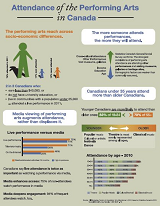 | 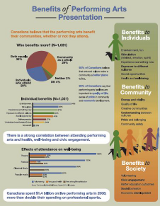 | ||
| Read the full report | View the infographic | View the infographic |
Canadian Atlas Online
If reading reports isn't your thing read on: I am thrilled that we were able to partner with the one-of-a-kind Canadian Geographic, in putting together a brand new, unique thematic for the Canadian Atlas Online. This thematic aims squarely at the public in general, and the education sector in particular. It offers a look at performing arts in Canada historically, geographically and in terms of the many benefits Canadians receive. And all that in short, to-the-point descriptions, videos and games! The team at Banfield-Seguin & Porkcoffee did an extraordinary job putting my scripts, finely edited by Canadian Geographic's team, together and making some complex concepts come to life in short and poignant videos! |
| http://www.canadiangeographic.ca/atlas/themes.aspx?id=performingarts&sub=performingarts_basics_introduction&lang=En |
Thursday, March 21, 2013
Marketing trends and getting real
... the internet is not new media: We are now 18 years in. An entire generation is alive now that simply lives with all things web as a normal part of their world.
Contemporary marketing is about storytelling, co-creating meaning, and making research and purchases easy and immediate.
Important marketing trends are those that leverage that fact.
A. Integration of websites with social networks and mobile
applications
C. Mobile Applications
D. Simplicity rules
So what is happening in marketing that all organizations should get smart about and determine the strategic implications for their organization?
Important marketing trends are those that leverage that fact.
A. Integration of websites with social networks and mobile
applications
Youtube was launched in 2005, Facebook and
Twitter came in 2006. Barely six or seven years old they have
an unprecedented reach ranging from about 500 million to 1 billion users. These are global platforms, with a reach that breaks most rules of geography. The increasing integration of services like Youtube, Facebook, Twitter with both desktops and mobile devices and within websites creates new dynamics between organizations and their audiences.
Marketers need to understand what these channels mean to their organization.
Recently, smart phones with touch screens,
tablets and e-readers with web access have become ubiquitous.
Great websites have evolved from early
brochure ware, UseNet groups and List serves to being hubs of
branded transactions with social media integration and mobile connectivity.
Seemingly limitless access to information,
easy consumption of entertainment, creation and sharing of content and
experiences has transformed how we behave, what we expect and what we want.
B. DIY
Websites used to be expensive custom
installations with IT infrastructure, benefiting from substantial user research and expert
programmers.
Today, WordPress and similar services have
become robust DIY web tools ("Software as a service") that work very well, have extensive plug-in options
for customization and keep costs very low.
Many of these off-the-shelf DIY tools can create a mobile-friendly version of a website on the fly. This
is important as more and more users visit websites using their mobile devices
with their much smaller screens.
Not every organization will want to go the route of DIY, but they have to know what's going on and what it means to their competitive positioning. (e.g. what are new competitive factors to consider when others adopt these tools?)
[Surveymonkey, another example of software as a service, has achieved over $1 billion in market cap - yes, that surely keeps some traditional research house executives up at night. Another is salesforce.com.]
C. Mobile Applications
The ‘appification’ of the online experience
has advanced rapidly in the last five years. Festivals, for instance, have quickly adopted
downloadable apps to stay connected with visitors. Several companies have
developed standard applications that offer affordable off the shelf solutions.
In my view, it is hard to imagine that any event without an app will be considered a leader in its field in the near
future. There are myriad other apps applications, some short-term and some durable: from news to entertainment to the frivolous to the life-altering.
D. Simplicity rules
Even as the world and technology has become
increasingly complex, people gravitate toward simple, easily recognizable
messages and calls for action.
The time of complex visual marketing is
long over (if that was ever more than a design fad) Simple images that convey a single core idea are used by strong
brands because they work. Anything that is not necessary to get to “yes”
merely gets in the way.
It is the difference between the completely uncluttered
Google search website with a single function and Yahoo search with content obscuring its main function.
The market leader usurped by the single-mindedly focused.
What is your take on these observations and the big issues you need to solve?
Subscribe to:
Posts (Atom)