Friday, February 18, 2011

Enriqueta Ulloa - Bolivian superstar delivers awesome performance

While in La Paz, Bolivia last November, we were invited to a concert by Enriqueta Ulloa. We had never heard of her, as her fame hasn't traveled north. We quickly learned, that she is a superstar: whenever we mentioned having been to this concert, Bolivians were so excited and started talking about her music, inspired by the traditional sounds and songs of the regions of Bolivia, as truly important and an important ambassador for Bolivian culture - and they were amazed that we even knew to go.
Two posters in contrast. She's so famous her image is all the
advertising needed.

That night she was celebrating 35 years on stage with back-to-back concerts! I've never seen a crowd so into every moment of a performance. Handkerchiefs twirling, clapping in the right rhythms and singing every song. The energy was incredibly joyous, the connection between artist and audience immediate, the love mutual. We were quickly swept up in this awesome vibe. This evening left me with one of the most powerful performing arts experiences I've had.

The performance included several numbers featuring traditional dance, some highlighting the band and others featuring the singer and of course costume changes and a selection of photos and videos from her long career (with the most awkward production set up but it just didn't matter - these were iconic images to many in the audience). As for the crowd: there were old people and children, there were powerful people and regular folks, there were men and women, there were city people and country people, those descended from Spanish blood and indigenous people - and there was one shared, joyous, Bolivian experience. An amazing moment in a country that feels so much in transition.

We were almost shocked at the cost of tickets: 30 Bolivianos each ($4.50) for 2nd row seats! By North American standards that's incredible - less so by Bolivian standards but still a relatively easy ticket to buy.
Scene before the doors opened.
The house was sold out and the
excitement obvious. 

The Municipal Theatre in La Paz dates to 1845; old,
beautiful, great vibe.
Here are a couple of Youtube videos for diversion and enjoyment.


Thursday, February 17, 2011

Do you pay someone so you can buy from them?

Click to enlarge view.
I just bought some tickets to a Melissa Etheridge concert. It should be great - we are excited about seeing here live again.

Because the online ticket seller adds fees like a "convenience fee" - basically a charge for the privilege of buying the tickets - I went to the box office in person.

For me all the "convenience" of buying online disappears when it adds $20 to the ticket price. And that's not all. If I were to buy them online I'd have to choose the delivery method: If I want to be sure to get them delivered, it's another $14.

Sure, I can pick them up at the venue or I can get them by regular mail (i.e. no guaranteed delivery) without additional  charge.  But here the "convenience" of buying online falls apart: I still need to leave my house and walk into a physical venue. Today, there should be a free option to download and print the e-ticket, just like with airlines, and some other ticket sellers.

My actual purchase cost me $197.00. Buying it online would have cost $231.00
(Well, arguably only $217 if I pick them up in person; so I went to buy them and pick them up in person at the same time and leave $20 - or $34 depending how you look at it - in my pocket for another performance.)

Nonetheless, this made me ponder other industries where the customer has to first pay for the pleasure of buying something.  I've come up with:
  • Credit cards - even though everyone has a "no fees" option these days, cards with fees are also still very common. 
  • CostCo membership - the annual membership fee gives customers access to amazingly low prices on all kinds of goods. 
  • Investing in mutual funds. The transaction fees are usually well hidden - OK, there's a total lack of transparency. And there is a thing called MERs and they do cost you, also quite hidden from view. 

Consumers pushed the credit card industry to include no-fee-cards in their portfolios. Given that many credit cards continue to charge around 20% interest on any balance, you'd think that's plenty to profit from.

CostCo on the other hand appears to have found a working formula where the value proposition works really well. The fee represents a fair exchange, and might well keep CostCo in business. The whole business model is fascinating and it has made CostCo one of the largest retailers in the world.

As for mutual fund transaction fees, front-loads, no-loads and MERs - my feeling is transparency should be a given in all financial transactions - and I am amazed this has not been assured as yet.

Where else do you pay in order to make a purchase? And what's the experience like? Does it alienate or bring you closer to the company?

Wednesday, February 16, 2011

What are they thinking at BlackBerry?

Just last week I used the Canadian edition of the BlackBerry website. It gave me all the information I needed quickly and efficiently in a pleasing, professional interface and I was happy.

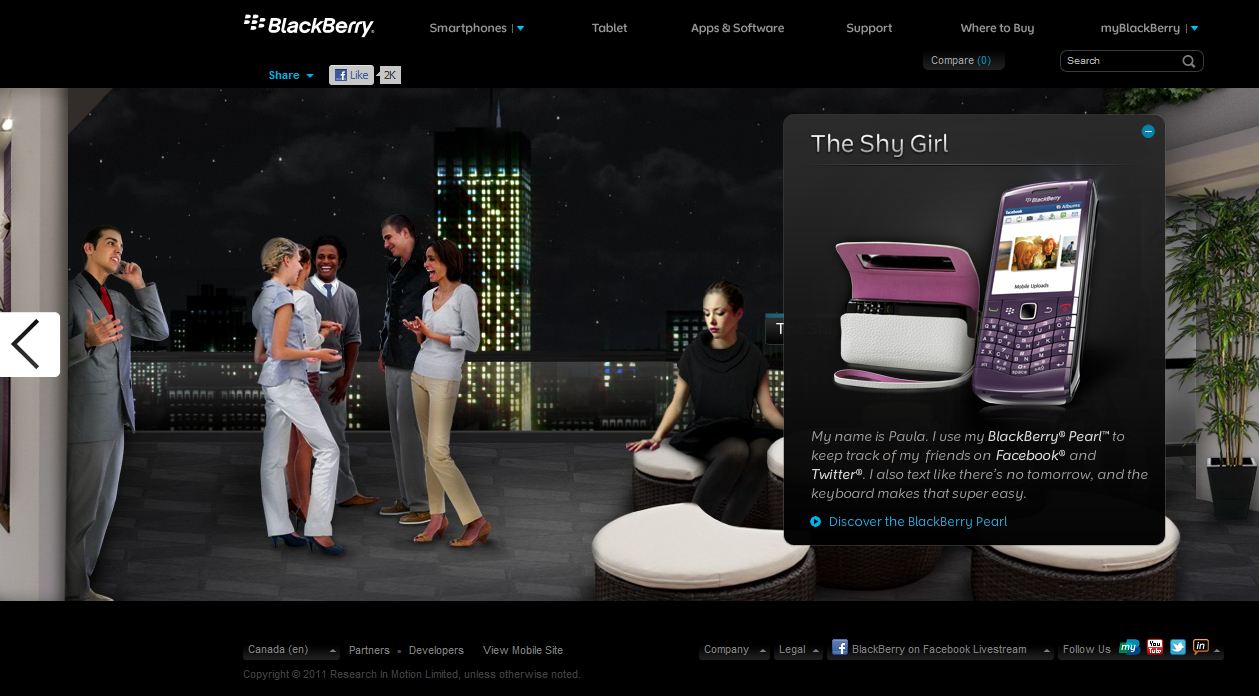
This evening I went to the site and saw this as the homepage: a rather static screen trying hard - and failing  in my books - at a lifestyle branding for BlackBerry.

Today BlackBerry is the leader in the smartphone market, but it's obvious that the Android platform and iPhone are growing faster than BlackBerry. To protect their position and keep growing they have to do something.

But static and boring web interface? All I get to do is go left to right or right to left and click on user types like "The Shy Girl" or "The Power Couple" to see what BlackBerry device they should be using.


Apparently if you are The Shy Girl you use the BlackBerry Pearl. I wonder how all the BlackBerry Pearl users out there feel about that. "Hey, you have a BB Pearl, you must be the shy girl who texts a lot." I mean how does that help someone gain status in their social circle? I was looking at getting the BlackBerry Torch, except now I am told that I am apparently broadcasting that I am part of The Power Couple! The truly powerful usually have little need to broadcast such things, they simply are and they act, so where does that leave me?

What are they thinking at BlackBerry? What's the insight at work here?
Have they heard of video and all the really cool things they could do by integrating video into their site - or better yet, why not just keep it clean and professional until you have a great lifestyle brand idea that you can make work online? So many ways to advance a lifestyle brand, so much to learn!

NB: We just saw anther number 1, Nokia, do something about the threats to their leadership position: announcing a strategic partnership with Microsoft, for better or worse. Hope they will open up that platform widely so they can garner the creativity and imaginations of apps developers everywhere.

Tuesday, February 15, 2011

Logo evolutions

I enjoyed this brief, visual survey of global brand logos. It's fun to see both what has changed radically and what has merely evolved, sometimes subtly, over the decades. The biggest changes in logo design in these examples are driven by shifts in the business or in its context. In that sense branding cuts both ways: brand designs do lead and they do follow trends.

Corporate brands are much more than the corporate name, even as wordmarks remain crucial for many brands and are likely more important the more local a business is. In any case, you will see several logos in that list that have become powerful enough to omit their company names entirely. Few do so because the image is the name, as is the case for Apple or Shell. With others you might wonder about the thinking or the research that led that decision.

Monday, February 14, 2011

Anti-marketing? Real estate issues in Bolivia

To North-American eyes this was a thoroughly surprising message:

"Esta casa NO está en vente" (This house is not for sale.)

Anti-marketing? Why write that on a building?

Turns out the anti-message is rooted in changes taking place in Bolivia under the government of Evo Morales, the country's first indigenous president, even though the majority of Bolivians are indigenous. 

Speaking with some of the property-owning locals we learned that it has become increasingly difficult to maintain ownership of anything other than the house they live in. It appears it has become relatively easy for squatters to gain title to unoccupied properties. One person we spoke with, told us they were paying someone to live in a second house they own, in order to protect their ownership. Yes, you read that right. They are paying someone so when they want to use the house in another way in the future they are able to because it is still theirs. 

This also explains some of the other unusual notes scrawled in large letters in properties that weren't in use, such as land without buildings. That message was usually something like "This property belongs to [insert name] and it is not for sale. [phone number]"

This was a good reminder to never assume that our own economic, social or cultural context is some kind of gold standard for how things "should" be and what we expect of others.