Showing posts with label branding. Show all posts

Wednesday, October 1, 2014

Why simplicity is key to marketing success

As our world and technology have become increasingly complex, people gravitate toward simple, easily recognizable messages and calls-for-action.


Let's agree: The time of complex visual messaging in marketing and advertising is over. Collages are dead.

A simple image that conveys a single core idea are favoured by marketers and brand managers because they work. In essence, today anything that is not necessary to get to “yes” merely gets in the way. 

It is the difference between the completely uncluttered Google search website with its legendary a single function, and Yahoo search where myriad content has come to obscure its (former) main function. 

The challenge is that arriving at simplicity is hard work. It requires a focused purpose and a great deal of clarity. It requires knowing who exactly your message needs to speak to and convince to pay attention and a deep understanding of what breakthrough communications are about, what they must over come. 

Our brains are designed to edit out information, to ignore clutter, to disregard anything that doesn't look immediately pertinent. 

Great marketing gets past those hardwired gatekeepers. And great marketing has to be singular, direct and address an important target market motivation. 

Hallmarks of effective communications

  1. Purpose
  2. Specific target audience
  3. Relevance to audience
  4. Clarity
  5. Consistency
  6. Suitable medium
  7. Repetition
  8. Multi-channel
  9. Conversation
  10. Evaluate and Learn

Components of effective messaging
  • Message (what you want to say)
  • Redundancy (used to emphasize the message – can be image and text working together)
  • Decoration (Embellishing to increase attractiveness and get attention)

Noise is all the things that interfere with the intended message.  In the arts, as in other sectors, an important issue remains learning to reduce the noise in our marketing and to focus on the single most important audience motivation to connect an experience with that audience. Because, ineffective marketing - the kind that has no clear message which means there is no redundancy or useful embellishment, and therefore there is no noise reduction and results simply in information overload which humans are designed to simply dismiss -leads to "No." 

Embracing the challenge of simplicity means honing a more rigorous process to arrive at effective communications that have the power to connect with your intended audience.


Saturday, September 13, 2014

Marketing Trends - New Media as The Media

Marketing has changed irrevocably over the last 10 to 15 years. While the harbingers of consumer power were evident in the late 1990s, with the advent of the Internet and mobile and then smart phones, the changes have now solidified and they continue to accelerate.

The web is no longer a new media. The body of knowledge and practice of integrated marketing has grown up.

Integration of websites with social networks and mobile apps

Youtube was launched in 2005, Facebook and Twitter came into the public view in 2006. Barely approaching a decade old they have an unprecedented reach ranging from 500 million to 1+ billion users.

Recently, smart phones with touch screens, tablets and e-readers with web access have become ubiquitous.

Great websites have evolved from early "brochure-sites", UseNet groups and List Serves to well functioning hubs of branded transactions with considerable social media integration and mobile connectivity.

Seemingly limitless access to information, easy consumption of entertainment, and creation and sharing of content and experiences have transformed how we behave, what we expect and what we want.

Contemporary marketing more than ever is about compelling stories, co-creating meaning, and making research and purchases easy and immediate. The increasing integration of services like Youtube, Facebook, Twitter and many more – with both desktops and mobile devices and within websites – creates new dynamics between organizations and their customers.

Today, website pages can be shared with a push of a button to a user’s social media universe. They can be used to amplify a use's own brand and they can be used to ridicule or support an organization or a product. It can raise awareness, start conversations or elicit sales through these wider social networks. Similarly, organizations are cross-linking their web sites and social media presence to provide a seamless user experience, going where users are.

Do-it-yourself

Websites used to be expensive custom installations, with the best requiring substantial user research and expert programmers.

Today, WordPress and similar services have become robust DIY web tools that work well, have extensive plug-in options for customization and keep costs low.

Many of these off-the-shelf options also have an embedded option to create a mobile-friendly version of a websites. This is important as more and more users visit websites using their mobile devices and their much smaller screens.

Mobile applications

The ‘appification’ of the online experience has advanced rapidly in the last five years to the point, where man of us retain little awareness that apps use online content, i.e. content that resides on a server elsewhere. The best apps are content and feature rich, while super simply to use.  

Festivals have embraced them to deliver a variety of information and on-site experiences. Here again, there is a build it once and sell it many times philosophy, enabling affordable, ready-made solutions to almost any size event. 

Today, apps live on non-standard operating systems, i.e. apps are developed for the various platforms of smart phones. That means, if resources require development for just one platform, considerable thought has to go into who the target market is and the dominant platforms in use.

The power of accessing rich content through tiny devices that one carries everywhere creates a brand new dynamic of relationship to and expectation of brands. 

Sunday, August 24, 2014

New marketing mind set in performing arts


Here are three vital elements to performing arts marketing and by extension a thriving arts scene:

1. Arts and cultural research has confirmed time and again that the performing arts sector is not a zero-sum field. Rather, Canadians become ever more likely to attend based on prior attendance at cultural events and performances. These behaviours are strong predictors of attendance while basic demographic factors are much weaker. That means, competition in the performing arts is not other performing arts organizations but rather all the other ways people spent their leisure and entertainment funds. Community-wide, true partnerships should become the rule not the exception in the performing arts.

2. I have a growing body of work that recognizes that performing arts are not only a show on a stage, but that all surrounding aspects contribute to the audience experience either positively or negatively. It is about full experience design.

This graphic represents key elements of the audience's arts experience that can and should be fully designed. All have the power to make or break the audience experience, put up barriers to it or enhance it. 
It means applying end-to-end design thinking including all the ways in which audience members can amplify the arts organization’s message and reach among their own networks.

Pricing and packaging are aspects that are often taken for granted due to a persistent belief that the arts do not suffer from sticker shock; that if someone really wants to see a show they make it happen. Well, price elasticity is real in the arts, too. The higher the price the fewer people will consider attending. Therefore, considerations should be given to how to price shows that are not expected to sell out at a given price point or that are not selling out despite seemingly well-founded expectations of that. Each of these aspects merits full consideration in your planning and in your evaluations afterwards.
3. Another important idea is that marketing materials are designed for specific purposes to address where a member of the target audience is at in the purchase decision process. Arts marketers need to use the full array of tools in research and evaluation to see how their marketing programs are creating the desired response or not.

An arts marketer's job is not merely to sell the workhorses of the performing arts - anything by Beethoven and Mozart, Nutcracker and Swan Lake, Shakespeare -  but indeed to lead larger and larger audiences to contemporary, current live professional performing arts experiences that they don't already know.

To do this requires the integrated use of contemporary marketing strategies and tactics. It is about compelling storytelling, co-creating meaning, and making research on events and purchase of tickets easy and immediate. The increasing integration of services like Youtube, Facebook, Twitter with both desktops and mobile devices and within websites creates new dynamics between organizations and their audiences. this is a good thing.
Today, website pages can be shared with a push of a single button to a user’s social media universe (Brookside’s site does this well) and it can raise awareness, start conversations or elicit sales through their social networks. Similarly, organizations are cross-linking their web sites and social media presence to provide a seamless user experience, going where users are.

This mind-set approach makes clear that an organization’s brand is more than a logo applied consistently. it is how it behaves and interacts with current and potential customers. Or perhaps it reaches even further: it is an entire eco-system's way of being and interacting in the world - and how the sector (and the communities it inhabits) thrives will depend on this concerted action.


Thursday, March 13, 2014

Arts Marketing ... or Orchestras are not for everyone

I came upon this discussion of the state of orchestral music in response to Ivan Katz' analysis  of the Chapter 11 bankruptcy proceedings entered by the Philadelphia Orchestra Association early in 2011.

I am entirely unfamiliar with the specifics of these proceedings. In particular the forum posts by a Thomas Alan Broido prompted today's post referencing something I wrote about: "Imagine: creating a brand new genre of live music making today!"

I implicitly suggested that the product/service - "live orchestral music" - would be targeted at a particular segment of the population. Taking a segmentation approach in the first place implies that ticketed (paid) orchestral music is not for everyone. That is not to say that classical music or orchestral music is not for everyone; putting a price tag on it, however, diminishes audience and market potential.

I continue to collect compelling evidence of the intrinsic values and benefits of arts and cultural participation. When the belief in these values and benefits are transferred directly to the ticketed performing arts things become murky. The unshakable importance of the arts as a public good is challenged when box office revenues must be achieved which restricts access which means the public good takes a lesser role, one balanced with revenue imperatives.

To peel back the onion on this conversation could yield new ways of thinking about the performing arts and about orchestras specifically. Thinking about what an orchestra or a theatre offers its paying customers and how to market that vigorously is qualitatively different from what an orchestra would consider if the public good, the health and well-being of the community, was of foremost concern.

On recent travels on Canada's east coast, I have been discussing his very thing, and I realize that we pay for many pubic good, hydro, food, snow clearing - without them becoming a lesser public good. In the arts, it creates a bona fides marketing scenario, that other areas experience in different ways and in some areas less so. Snow clearing happens through taxation. Hydro development, too, even where there is competition for delivery and such. Food is super competitive, but the staples much less so. Arts, professional arts, actually need to be excellent at break-through marketing and attention getting engagement to command a serious ticket buying commitment. And I know it can be done. (See Cirque du Soleil).

I have been talking about some case studies in the arts demonstrating integrated marketing strategies. Amazing how language I used corporately in the 1990s is so top of mind now in the 2010s. Perhaps it's just my way of integrated thinking. :)

This is a link to the Atlantic Presenters Association newsletter discussing my East Coast presentations and workshops, in early March. So happy to see this amazing feedback. I got to connect with 110 Atlantic arts organizations in one trip. Just amazing.
http://us1.campaign-archive1.com/?u=98ddd3c7538d70d3aa9945907&id=041f96aa01&e=3ce7dd33bd

We can do so much, when we combine the best from all disciplines that help us connect art and audiences. Including full on Marketing. 

Tuesday, February 25, 2014

Social web strategy for the performing arts

"Many arts institutions even allow their audience members to write their own critiques on the organizational website. This is a scary trend." Michael Kaiser, President at Kennedy Centre for the Performing Arts, blogging on HuffPost, a while back.

It's not clear to me whether he thinks the ability of people to engage with each other is positive or negative for the performing arts, but he definitely says it's scary. (He might have meant that with regard to the demise of news-media critics and the rise of patrons providing their opinions online.)

In any case, in 2011, year 16 of the commercial internet, this amazes me.

It is neither scary nor new that arts patrons share their thoughts, reactions and recommendations about performing arts events.

Yes, the speed of this sharing is near instant - and potentially widely distributed - in the age of mobile technologies. Smart companies would want to harness this user generated content (UCG) on their own platforms as much as possible and indeed, they'd participate.

Imagine a social web strategy for a performing arts organization predicated on authentic relationships between their organization, artists and audiences: They might thank audience members for feedback, positive reviews, questions and being interested. The artistic director might comment back when they see a reaction that they want to shift to a different place. They could have a conversation and share information and perspectives. They might answer those "what were they thinking!" questions that people post on Facebook, Twitter or on blogs. Marketing staff could retweet and amplify the positive reviews you get. The company could give the behind the scenes insight, tell the back stories and facilitate creators, actors, musicians, dancers to speak for themselves (many do). They would not abuse these relationship for quick ticket sales, but they might occasionally highlight upcoming shows in their venue and in others. They might rally everyone around the love of the arts and spread it.

Can you imagine the power of these interactions for your company - your brand - in the long run?

For years, user generated content has been coveted by consumer companies and entire strategies have been thought up to get it - using contesting, short codes, value added info, exclusive perks. I used it as part of a place branding project for a city in Eastern Ontario back in 2007 with great results. Dove's Campaign for Real Beauty put an interesting spin on the genre. Today user generated content (the social media) has become ubiquitous through social networks (that's the platforms) and the real challenge is not the generation of it, but the harnessing of the conversation real people are having about you, your services, your products. (Real people is key, because there are all kinds of spam engines, and fake UCG where companies or their agents act as imposters - this is not social and it is not what I am talking about.)

The true irony might lie in what great art has the power to do:

It is supposed to be a conversation; an exchange between orchestra and audience through music; an exchange of ideas in theatre; a kinetic exploration through the body in dance; an entertaining experience (in the best sense of the word). It aspires to be: emotive, beautiful, thought-provoking, stimulating or even transforming. It examines the human condition. It can connect people both to each other and to a higher plane of being in whatever way they choose. It can foster greater understanding across cultures or socio-economic groups. And it does it by carrying on the conversations outside of the performance space.

I think, those arts organizations who have figured out to become part of the conversation are to be congratulated and celebrated. That's why I celebrate the vision and smarts at the National Arts Centre in Ottawa, or Shell Theatre in Fort Saskatchewan, Alberta. (Please add others who do it well in the comments below.)

They may just have realized that the conversation goes on without them anyways. And they can build authentic relationships by inviting audiences not only inside their theatres but inside their web presence, too.

Finally, new audience engagement modes reflect a generational as much as a technological shift. Back in 2006 even Time magazine had figured out the signs of the times by declaring You, yes, YOU, its Person of the Year.

By the way, Twitter and Facebook were in their infancy in 2006. Notably, Time's Person of the Year for 2010, was Mark Zuckerberg. The speed of business has increased tremendously and it demands nimbleness and adaptablility more than ever.

Monday, February 24, 2014

Artistic Risk and Branding

Creating a strategic framework to achieve value innovation  means we need to ask basic questions as if they were brand new. For example, what does "taking artistic risks" mean from an audience perspective?

The answer is that "it depends": Each audience member determines "risk" using a slew of criteria to figure out under what circumstances it might be worthwhile to not actually enjoy a performance that one paid for and made time to attend.

Personally, I attend several performing arts on subscription - the ultimate commitment much of the performing arts still relies on. I have different expectations from different art forms. In terms of classical music voluntary risk taking is limited to listenable music (I have little tolerance in the orchestral setting for dissonance). In contemporary dance, I look for the new and unexpected, as long as the dancers are top notch and indeed are dancing. In theatre, I like intellectual, thought-provoking work and I like a great deal of variety, too, including some great brassy entertainment that tells a great story. I also really like mash-ups that blur the boundaries of art forms by taking the best from each and creating something even greater. (Fela!, which I saw at Toronto's Canon Theatre, is an extraordinary example of that.) 

I have just established, in my singular experience at least, that it is possible within the same person to evaluate risks quite differently depending on the context.

The very idea of "artistic risk" is highly subjective. For instance, not all risky programming is innovative, and what's perceived as a risk in one city may not be so risky in another. Risk is contextual not absolute.

Performing arts audiences are diverse in tastes, expectations, culture and background. Those who can afford tickets easily will evaluate risks differently from those who have to give up something else in their life in order to save up for tickets.

Effective branding is critical to success 
I propose that developing and living a strong, singular brand is the best way for creators and presenters of artistic experiences to help their audiences decide to give all manner of experiences a try and to invest their time and money.

The brand becomes the touch point, the guarantee of a thoughtful and respectful arts experience, whether or not it's "entertaining", "provoking", "escape" or "stimulating". 

Robert LePage when receiving the Governor General's Performing Arts Award recognizing his body of work was quoted about not wanting to be merely "international" but "universal." (Watch the short NFB film here.)That is a quintessential brand statement, captured in a single word. It is awesome! It is a strong brand statement within which he can explore all manner of ideas in myriad ways; it's not limiting but rather gives a meaningful contour to his work and aspiration.

He talked about his visual language of theatre evolving beyond the spoken word and to borrow from other forms of storytelling that are familiar for contemporary audiences - most important being film. From a brand point of view, that means he's breaking free of the "traditional" bounds of one art form in order to bring his vision to life and to stay relevant. It's an act of reinvention, which is requisite to maintaining brand relevance in the long-term.

Societies, communities, people, technology have been changing rapidly - socially, politically, environmentally, economically, (multi-)culturally. Every industry, every sector in society must change in relation to these external challenges. Those that will succeed are those that will bring audiences, customers, consumers along on the journey. 

I propose that to define and embrace a comprehensive brand (not a logo, but a way of being), one relevant to audiences and stakeholders in your community, is the most efficient and effective way to connect the arts, artists and audiences to create success. 

As a researcher, strategist and marketer I have the tools to help clients build powerful brands. I also have learned that many people have a limited understanding of the breadth of what branding is and does. As I continue to contemplate value innovation in the performing arts I will share from my experiences in brand research and development.

Wednesday, February 5, 2014

Value Innovation: From participation to attendance in the live performing arts

Important to achieving value innovation is responding to and building on what captivates audiences and, sometimes more important, potential audiences.

Today I listened to a really interesting CBC radio call in show on "Why live theatre is dead to you." It is well worth a listen to the wide range of views expressed by callers. Several pointed out that they simply don't know what is available. And that they have had disappointing experiences. (Diagnostically: these are marketing and programming/production issues.) By the way, for most live theatre wasn't actually dead, just not in reach for these and other reasons.

This week is rich with well considered coverage: like this article in the UK's Guardian on What do audiences want I read yesterday.

Not surprisingly, there are examples of arts organizations learning about being relevant in new ways.

At the National Arts Centre Orchestra, a new initiative called Casual Fridays, innovates on the classical concert experience expressly to reach and engage a new and younger audience. This includes a much more casual and friendly concert hall experience. NAC English Theatre (Youtube video) is using inventive marketing campaigns to generate buzz and bring the NAC to the streets of Ottawa to invite patrons to a night at the theatre.

Yet, by and large, the voices of those who continue to hold fast to conventions and traditions and a belief in the arts in and of themselves appear strong. And far removed from the younger generations interests, values and attitudes.

This is the "young audience" (Gen Xers are about 35 to 49 years old today) orchestras, for instance, need to attract in large numbers in order to replace not only aging highly committed patrons, but the revenue they represent. That means quite likely for many orchestras - and theatres and dance, too - not a 1 to 1 replacement strategy but a 3 or even 4 to 1 replacement imperative.

Research on participation and attendance
The Ontario Arts Council affirms in its Ontario Arts Engagement Study (lead by WolfBrown and released in October 2011), that not merely engagement but participation in the arts experience is where it is at from the audiences' perspective.

Key findings from the study include: "Involvement in participatory activities is linked to attendance at audience-based activities – Overall, people who engage in participatory arts activities are more likely to attend audience or visitor-based activities – sometimes at a rate of two or three times higher than those who do not engage in participatory activities."

And it leads the study's authors to ask: "How can arts organizations build bridges between participatory forms of engagement and professional arts performances and exhibits?"

From an institutional perspective the goal has often been to "get bums in seats", ie attendance. Personally, I detest this phrasing, because it reduces the audience in the most unhelpful ways. 

Imagine yourself shift the institutional end-game to the audience perspective. In what ways, if any, would it change your understanding of how to connect meaningfully to audiences and potential audiences? How would this change what you do in your quest to foster specific attending behaviours in audiences, like subscription renewal perhaps or some other repeat purchase?


And, honestly, how effective is your organization at marketing its shows? In the simplest terms, marketing is the process by which services and products are brought to market. Marketing is about the relationships you build and about trust and mutual respect; in my view it is not about "bums in seats." (That is a short-term sales approach.)

Thursday, March 21, 2013

Marketing trends and getting real

...  the internet is not new media: We are now 18 years in. An entire generation is alive now that simply lives with all things web as a normal part of their world.

So what is happening in marketing that all organizations should get smart about and determine the strategic implications for their organization?

Contemporary marketing is about storytelling, co-creating meaning, and making research and purchases easy and immediate. 

Important marketing trends are those that leverage that fact.

A. Integration of websites with social networks and mobile applications

Youtube was launched in 2005, Facebook and Twitter came in 2006. Barely six or seven years old they have an unprecedented reach ranging from about 500 million to 1 billion users. These are global platforms, with a reach that breaks most rules of geography.  The increasing integration of services like Youtube, Facebook, Twitter with both desktops and mobile devices and within websites creates new dynamics between organizations and their audiences.

Marketers need to understand what these channels mean to their organization.

Recently, smart phones with touch screens, tablets and e-readers with web access have become ubiquitous.
Great websites have evolved from early brochure ware, UseNet groups and List serves to being hubs of branded transactions with social media integration and mobile connectivity. Today, website pages can be shared with a push of a single button to a user’s social media universe and it can raise awareness, start conversations or even elicit sales through their social networks. Similarly, organizations are cross-linking their web sites and social media presence to provide a seamless user experience, going where users are.

Seemingly limitless access to information, easy consumption of entertainment, creation and sharing of content and experiences has transformed how we behave, what we expect and what we want.

B. DIY

Websites used to be expensive custom installations with IT infrastructure, benefiting from substantial user research and expert programmers. 

Today, WordPress and similar services have become robust DIY web tools ("Software as a service") that work very well, have extensive plug-in options for customization and keep costs very low. 

Many of these off-the-shelf DIY tools can create a mobile-friendly version of a website on the fly. This is important as more and more users visit websites using their mobile devices with their much smaller screens.

Not every organization will want to go the route of DIY, but they have to know what's going on and what it means to their competitive positioning. (e.g. what are  new competitive factors to consider when others adopt these tools?)

[Surveymonkey, another example of software as a service, has achieved over $1 billion in market cap - yes, that surely keeps some traditional research house executives up at night. Another is salesforce.com.]

C. Mobile Applications

The ‘appification’ of the online experience has advanced rapidly in the last five years. Festivals, for instance, have quickly adopted downloadable apps to stay connected with visitors. Several companies have developed standard applications that offer affordable off the shelf solutions.

In my view, it is hard to imagine that any event without an app will be considered a leader in its field in the near future. There are myriad other apps applications, some short-term and some durable: from news to entertainment to the frivolous to the life-altering.

D. Simplicity rules

Even as the world and technology has become increasingly complex, people gravitate toward simple, easily recognizable messages and calls for action.

The time of complex visual marketing is long over (if that was ever more than a design fad) Simple images that convey a single core idea are used by strong brands because they work. Anything that is not necessary to get to “yes” merely gets in the way. 

It is the difference between the completely uncluttered Google search website with a single function and Yahoo search with content obscuring its main function. 

The market leader usurped by the single-mindedly focused. 

What is your take on these observations and the big issues you  need to solve?

Monday, May 7, 2012

Report published: Value of Presenting revealed

This spring my life has been dominated by writing. The result is a major milestone for the Value of Presenting: A Study of Arts Presentation in Canada.

In this Interim Report of Findings I consolidate the facts and figures on the value and benefits of performing arts presenting in Canada gathered over the last year through two national surveys (288 presenters and 1,031 Canadians), participation at conferences, leading dialogues and interviews with the presenting field and those found in the literature. Additionally, it presents a profile of the performing arts presenting ecology as a whole and highlights how several groups of presenters are distinct; for instance, those presenting works for aboriginal communities, francophone minority (those operating outside Quebec) and those in rural and remote communities.

The Interim Report of Findings:
http://www.diffusionartspresenting.ca/2012/05/07/interim-report-of-findings/

French-language executive summary:
http://www.diffusionartspresenting.ca/2012/05/07/rapport-interimaire/

The supplementary report on francophone minorities and presenting in Canada, with additional data:
http://www.diffusionartspresenting.ca/2012/05/07/diffusion-francophonie/

Writing is both solitary and communal. My thanks and appreciation go to the project manager at CAPACOA, Frédéric Julien, for reviewing everything and co-writing the French report. And my colleague, Pierre Lacroix, who has been leading the consulting work with the francophone communities and co-wrote the French-language report.

Over the next year, I will continue to explore the implications of these and other findings with the presenting field across Canada. In March 2013, we will publish a final report on the Value of Presenting in both English and French.

This next week, I will lead two webinars for rural and Northern presenters to review findings and begin conversations on the "So, what" part of this work. For webinar information: http://www.diffusionartspresenting.ca/events/

Tuesday, March 20, 2012

Ottawa is putting it all together for Juno Awards Week

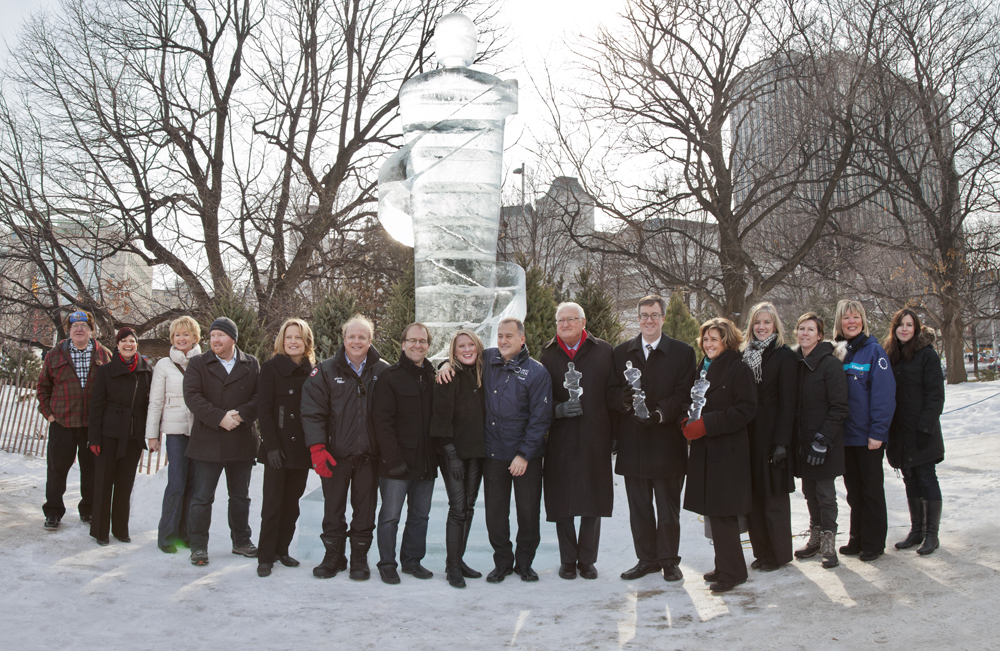
Being invited to participate on the Ottawa Host Committee for Juno 2012 has offered me a deeper perspective of the tremendous teamwork, expertise and volunteerism needed to bring a major national event to a city. Ottawa's institutions are very well practiced in producing major events, having made that an important pillar of economic development activities in the region.

Members of the Host Committee with the Juno Ice Sculpture.
This collaboration ranging from the NCC and the City to Aboriginal and Francophone communities, from the Chamber of Commerce and local BIAs to museums, transportation hubs and local media partners to the universities, and, of course, the local bar/ music scene is awesome. Sponsors are also a key part in the "making it go" equation.

Producing and promoting a major event is a complex choreography. To make it go requires diligent effort, involvement and engagement of people and communities, and a flexible plan. Knowing the many innovative marketing and "civic animation" ideas we have generated to help bring a buzz for the Juno Awards and Canadian music to Ottawa and the nation is simply cool. Many of these ideas have been put in place. Any that aren't seeing the light of day due to time and resource constraints will be well worth revisiting in the future; especially those that involved more advanced uses of communications technologies.

Meanwhile, partnerships like this one with the University of Ottawa/Ottawa Host Committee/ MASC are using technology to bust wide open the sacred walls of learning through video-conferencing master classes with leading musicians across Canada.

http://www.junoawards.ca
In the best of worlds, major events serve the visiting organization (CARAS, in this case), its constituents (music industry and musicians) while providing unique opportunities for participation to the local community and, at the same time, elevating the brand of the city in the Nation's psyche. On April 1, Canadians will see Ottawa once again for what it is - a vibrant city and a diverse people much beyond the day-to-day political machinations inherent in being a capital.  And almost better yet, all through Juno week from March 26 to the CTV Juno Award show broadcast on April 1, people in Ottawa-Gatineau get to celebrate Canadian music in bars, on the street and in concert halls across the region.

Juno Week in Ottawa: March 26 to April 1, 2012. 


Wednesday, November 30, 2011

"How can I sell tickets using Twitter?"

Have you ever heard someone ask: "How can I sell tickets using Twitter?" or "I have a lot of Facebook fans but very few seem to buy tickets to my events. I don't think Facebook works for me."

I have puzzled over such statements; I couldn't understand why anyone would measure these social media platforms by their capacity to achieve direct sales  --- whether of tickets or widgets or gadgets.

In my mind, social media were, well, social.

Social means relationships. Social means conversation - mostly consumer to consumer, but also consumer to brand. Social means mutual respect. Social might mean recommendation. Social can mean someone buys something based - at least in part - on a social network interaction. But it all starts with authentic relationships, it's like being friends in the so-called real world.

Off I went looking for organizations using social media in exemplary ways, especially in the performing arts presenting field. This experiment is part of the Value of Presenting Study we have been working on.

The experiment: Interview by Twitter 
The topic: The use of social media and online technology in your performing arts organization.
The interviewees: Two arts presenters (read the transcripts here: Shell Theatre and the National Arts Centre) who use social media in exemplary ways and an agent who does, too.

Key findings:
1. Social media are about building relationships
2. There are other ways to sell tickets
3. Audiences engaged: mostly the 30 to 55 year-old crowd rather than "young people", even though one interviewees said they find Facebook and txt works with a Students Rush tickets program;
4. Hone your authentic voice
5. Experiment to see what works for your organization

It's fun to experiment with trying to help more people see what the strategic potential of social media in the performing arts presenting sector could be, by doing. In this case, it's not in direct sales measured by revenue, but in building relationships measured by quality of relationships, engagement and championship of the brand. It is not an old-style transactional relationship, but one that is mutually enriching, extends beyond attendance, and requires new, timely interactions. And they are a lot more public.

The importance of voice is a fascinating topic in the concise world of social networks. (As these interviews show, short texts can be extremely good at making clear points and sharing salient information.) Voice is a key brand attribute that requires honing and calibration.

I think the adoption of social media shifts an organization's brand into a new realm. As such, an evaluation  of  what an organization stands for and how it is and behaves in its world (in short an evaluation of market relevance), may well be an essential step toward embracing such contemporary marketing methods.

See my earlier post on Social web strategy for the performing arts.

Tuesday, November 22, 2011

In the face of uncertainty what's your strategy?


The economic, financial, political and social pressures playing out the world over (Arab Spring, summer and fall, EU sovereign debt, US Congress debt failure) do not mean we all disappear from the face of the earth any time soon.

These massive disruptions simply have become normal.

You do not need to act globally to feel the effects of uncertainty on your business. This is the time for organizations and individuals to re-evaluate their specific situations and build new contingencies, develop new strategies, uncover opportunities for value innovation. Your capacity to analyze, understand and adapt will shape your outcomes.

This is the time for the kind of iterative 360 degree research and strategy process I use in my practice, and others use in theirs. It is by examining internal and external factors and helping people evaluate various dimensions rigorously that together we can shape a powerful direction forward. More than hope it provides pathways for decisive action, grounded in fact and using built-in measures to recognize when course corrections may be necessary.

A few questions
Are your customers particularly stressed due to the financial market turmoil? Which customer segments are more affected and how?

If you are in the B2B sector, are you aware of your business customers current concerns and how you can enhance their opportunities?

As a for-profit or not-for-profit corporation how are you taking account of changes in your environment, in your customer base, among stakeholders? Have you re-examined the assumptions in your 1-, 3- or 5-year business plans, yet?

Are you part of an industry / a sector that has been struggling already to maintain a resilient customer base? Have you accounted for and created strategic responses to the alternatives challenging your products or services in the market today? Have you examined how your products and services are essential - or hard to replace - to your customers? 

How are you perceived in your community? How have you been managing your brand in order to create value and trust? How are you evaluating your impact on your community? 

How have you responded to the massive changes in consumer behaviour due to the internet and now mobile technology? How have you leveraged the new opportunities that come with online and mobile communications and what are the next opportunities?

These are a few of the questions worth considering. It's in part the impetus for the series of thought pieces I have been sharing on value innovation in the performing arts, a sector I care deeply about. The process is the same no matter the sector.

Monday, November 21, 2011

NAC musicians ‘gave up their clothes for their instruments’

Awesome!

That was the Ottawa Citizen headline on the story about a NAC Orchestra Atlantic tour concert in Charlottetown, PEI. CBC radio covered the story repeatedly through the day, even giving top of the news billing.

I wonder, if the Newfoundland ferry had not broken down, stranding instruments and performance clothes, how many Canadians would have been exposed to the NAC Orchestra even being on tour?

This concert sounded like an awesome experience for an appreciative audience. Looking at the performance images on Facebook of energized, passionate musicians in normal clothes, I can't help but think what a great brand builder this could be: The people's orchestra.

In any case, congratulations to the musicians, administrators and managers who handled this logistics adventure with such aplomb and got the media story of the tour in the process.

Monday, September 12, 2011

A bold, new arts brand: Ottawa Storytellers

We recently did some research and strategy work with Ottawa Storytellers (OST). Their goal was to further build on their existing audience with a focus on cultivating a younger, more culturally diverse audience.

With storytelling the challenge is two-fold: 1) many people do not think of storytelling as a professional, adult performing art; and 2) event promotion has not built broad-based trust and credibility in organizations producing or presenting storytelling events.

The challenge we faced was that OST needed to build much greater recognition for itself as a credible and trustworthy source of quality performing arts/ storytelling events and for storytelling as a bona fide professional art form with every communication touch point. At the same time, it needed to “sell” storytelling series or individual performances, without being encumbered by organization-level messaging.

Often in event-based marketing - and when marketing budgets are relatively small - there is little leverage or recognition accruing back to the arts presenter, except among the most committed audiences. That in turn creates long-term liabilities like needing to continually invest in one-off marketing of events, rather than being able to benefit over time from a mother brand approach where recognition, trust and credibility reside with the presenter, not only a specific artist/event. Such an approach creates all kinds of benefits such as more easily presenting new artists through reducing box office risk and more effective marketing. It was also important to understand that when growing an audience is the central goal then the strategy cannot rely on largely list-based marketing efforts alone.


Central Strategy: Mother Brand
Web banners for Storytelling series events.
Design by Annette Hegel, Ottawa.
That is why a central part of our strategy called for a new branding approach that would be cohesive, bold, contemporary, intelligent, easily structured and flexible in application, welcoming and inviting to audiences, and give weight to OST (this is where the relationship with the audience gets built) while also giving strong presence to show-specific information (which is where OST fulfills its artistic mission).

In short, OST needed to take its place at the heart of its marketing. It would be the mother brand from which all series and events would flow.

In our analysis, we had found the OST logo and tagline were already strong and we recommended keeping both. We found that many of their marketing and communications tactics including much of their online efforts were well conceived and executed. The visual branding, on the other hand, was less effective, too complex and hard to adapt. Similarly, there was, at times, no clear hierarchy of messages evident in marketing materials and the oft-observed "too much text, which ends up saying very little to anyone" was also sometimes an issue.

Creative Brief: Define Audience Using Psychographics
By defining the audience, we were able to create a target that felt real. We used a psychographic composite (values, beliefs, generation-based experiences), rather than just relying on demographic elements (age, income, etc) which are less meaningful, and certainly much less so in terms of creative direction.

OST has just launched its new web site which features its new branding approach. I think they did an excellent job translating the strategic direction into an effective brand architecture. 

What do you think?

Thank you to OST for agreeing to share the back story on its new strategy initiatives. 


Saturday, August 20, 2011

The Value of History

The Value of Presenting Study is  aimed at helping to shape the future for performing arts presentation. We could just look forward to establish that vision. It seems human nature to go from today to tomorrow; maybe that's because we are best suited to use ourselves as the reference point from which to understand the world. However, in my view, a full understanding requires knowing something about the evolution that got us to today. It serves to avoid myopia and to build on where we have come from rather than inadvertently move backwards. (It's possible!)

It's good to understand the genesis of Canada's very own cultural life to help it move forward in the next decade or so. Nation-building, international relations, identity-formation and export are all underlying Canadian cultural policy. Public funding of creative expression also holds all sorts of tension points, from discussions about "what is art" to establishing funding priorities.

One aspect of our team's work has been to collect a historic overview, starting from the earliest times in Canada as we know it today. The document is a work in progress (if you have things to add, please add  comments on the project site); we will update this file over the next few weeks with some of the more recent evolution we have gained in interviews and contributions from people who have been part of the sector for many years.

Wednesday, February 16, 2011

What are they thinking at BlackBerry?

Just last week I used the Canadian edition of the BlackBerry website. It gave me all the information I needed quickly and efficiently in a pleasing, professional interface and I was happy.

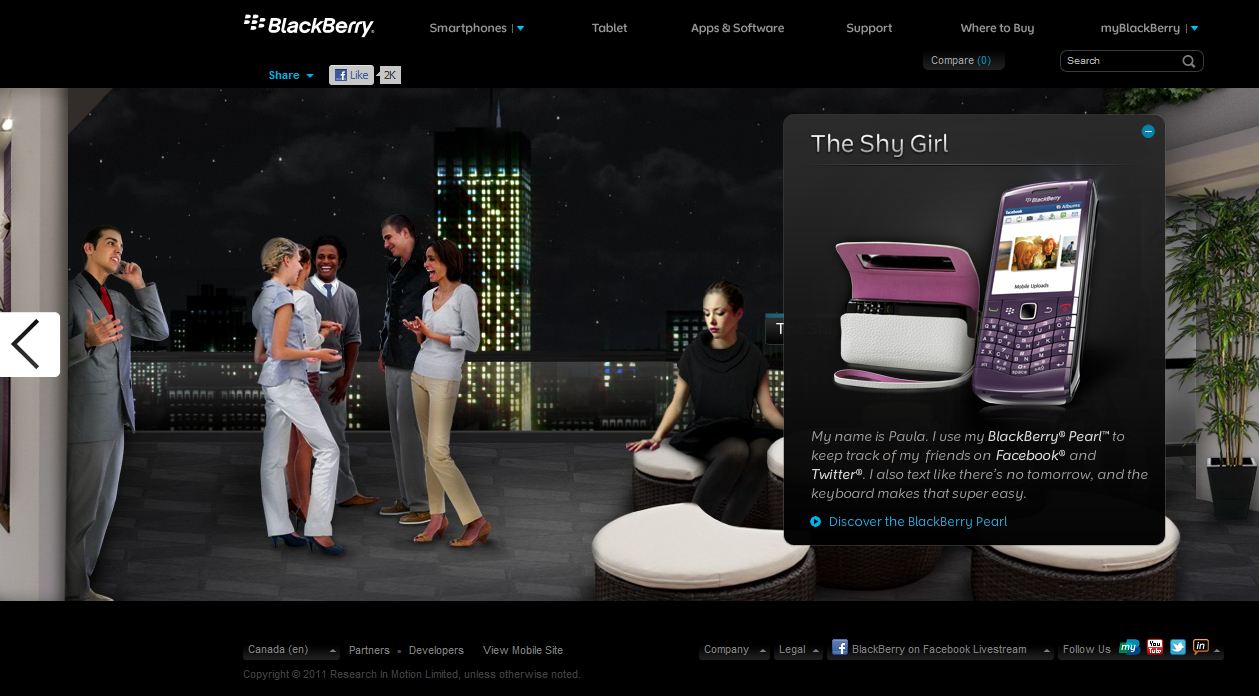
This evening I went to the site and saw this as the homepage: a rather static screen trying hard - and failing  in my books - at a lifestyle branding for BlackBerry.

Today BlackBerry is the leader in the smartphone market, but it's obvious that the Android platform and iPhone are growing faster than BlackBerry. To protect their position and keep growing they have to do something.

But static and boring web interface? All I get to do is go left to right or right to left and click on user types like "The Shy Girl" or "The Power Couple" to see what BlackBerry device they should be using.


Apparently if you are The Shy Girl you use the BlackBerry Pearl. I wonder how all the BlackBerry Pearl users out there feel about that. "Hey, you have a BB Pearl, you must be the shy girl who texts a lot." I mean how does that help someone gain status in their social circle? I was looking at getting the BlackBerry Torch, except now I am told that I am apparently broadcasting that I am part of The Power Couple! The truly powerful usually have little need to broadcast such things, they simply are and they act, so where does that leave me?

What are they thinking at BlackBerry? What's the insight at work here?
Have they heard of video and all the really cool things they could do by integrating video into their site - or better yet, why not just keep it clean and professional until you have a great lifestyle brand idea that you can make work online? So many ways to advance a lifestyle brand, so much to learn!

NB: We just saw anther number 1, Nokia, do something about the threats to their leadership position: announcing a strategic partnership with Microsoft, for better or worse. Hope they will open up that platform widely so they can garner the creativity and imaginations of apps developers everywhere.

Tuesday, February 15, 2011

Logo evolutions

I enjoyed this brief, visual survey of global brand logos. It's fun to see both what has changed radically and what has merely evolved, sometimes subtly, over the decades. The biggest changes in logo design in these examples are driven by shifts in the business or in its context. In that sense branding cuts both ways: brand designs do lead and they do follow trends.

Corporate brands are much more than the corporate name, even as wordmarks remain crucial for many brands and are likely more important the more local a business is. In any case, you will see several logos in that list that have become powerful enough to omit their company names entirely. Few do so because the image is the name, as is the case for Apple or Shell. With others you might wonder about the thinking or the research that led that decision.

Monday, February 14, 2011

Anti-marketing? Real estate issues in Bolivia

To North-American eyes this was a thoroughly surprising message:

"Esta casa NO está en vente" (This house is not for sale.)

Anti-marketing? Why write that on a building?

Turns out the anti-message is rooted in changes taking place in Bolivia under the government of Evo Morales, the country's first indigenous president, even though the majority of Bolivians are indigenous. 

Speaking with some of the property-owning locals we learned that it has become increasingly difficult to maintain ownership of anything other than the house they live in. It appears it has become relatively easy for squatters to gain title to unoccupied properties. One person we spoke with, told us they were paying someone to live in a second house they own, in order to protect their ownership. Yes, you read that right. They are paying someone so when they want to use the house in another way in the future they are able to because it is still theirs. 

This also explains some of the other unusual notes scrawled in large letters in properties that weren't in use, such as land without buildings. That message was usually something like "This property belongs to [insert name] and it is not for sale. [phone number]"

This was a good reminder to never assume that our own economic, social or cultural context is some kind of gold standard for how things "should" be and what we expect of others.